‘15’ (2003) by Royston Tan – The underclass of
Singapore
The Singaporean society,
which has always been associated with words like family-oriented, cultural,
developed, and well educated were not what Royston Tan portrayed in his
featured film, ‘15’. ‘15’ uncovered many insights into the Singapore society
that was left undiscovered. The film featuring 5 Chinese youths who were
streamed out of the system struck the society that places heavy emphasis on
meritocracy. Coupled with Media Censorship Law and being claimed to be a
“national threat” to Singapore, Royston was restored to cut 27 shots from his
film. (Something to remember, 2010)
The film is a true
reflection of the many perceptions hold upon these fifteen years old boys. It sets the society thinking whether are these
boys really what many Singaporean always associate them with – beyond hopes and
social burden. Setting himself different from many local filmmakers discussing
common issues like National Service and education system, Royston choose to
pull forward a film to document the life of a group of unwanted boys,
highlighting issues that was never discussed and made known before.
A directionless film with a
lack of proper story plots and professional editing implies the life of these
boys as someone who lose their identity and directions in life. The
film revolves around the inner struggle and the pain that these boys faced in
their pursuit to seek acceptance in this society.
Many skeptical Singaporeans
were portrayed seeing these boys in a different light in this
achievement-oriented society.


Student in school uniform mocking these street kids for their lack of education during a confrontation
Royston also highlighted the
phenomenon that some Singaporean may show several negative behaviors to this
group of people, even at a minor age. Sarcasm was exhibited towards their lack
of ability to speak English. Is our society always judging a person based on
their education level instead of who they really are? Is meritocracy in our
system performing at its intention to give a fair opportunity to every
individual?
As depicted in the film also,
these boys value brotherhood more than the “educated” one. They stand out for their peers despite
knowing that the law might punish them. As fearless and ruthless they can be,
they live their life not knowing what they are expecting tomorrow. They hold
strong animus to those who interfere their life. The uncertainty in their
future shaped them to take whatever that comes in their way in their
unconventional lifestyle.

These uncivilized youths also portrayed a selfless personality in them as they are more than willing to share whatever they have with each other (ie. Cigarettes). it sets many audiences who are well off to pondering upon their own behaviors. Being in this competitive society, everyone tend to be a little reserve but this is not in the case in these youths.

Sharing of the last cigarette.
The film also highlighted the issues of self-harming that these youths are resorting to. The pain that they inflict on themselves is a demonstration of rebellion that many may not see and understand. These homicidal ideations remain a worrying issue to the society.


The film uncovers the unconventional lifestyle showing how they are like living without proper parenting. These youths are restored to seek love and attention in a peculiar way due to the absence of love and attention from a typical Singaporean home.

These uncivilized youths also portrayed a selfless personality in them as they are more than willing to share whatever they have with each other (ie. Cigarettes). it sets many audiences who are well off to pondering upon their own behaviors. Being in this competitive society, everyone tend to be a little reserve but this is not in the case in these youths.

Sharing of the last cigarette.
The film also highlighted the issues of self-harming that these youths are resorting to. The pain that they inflict on themselves is a demonstration of rebellion that many may not see and understand. These homicidal ideations remain a worrying issue to the society.


The film uncovers the unconventional lifestyle showing how they are like living without proper parenting. These youths are restored to seek love and attention in a peculiar way due to the absence of love and attention from a typical Singaporean home.


Royston Tan also portrayed the naïve and unsophisticated mentality of these youths by using amateur animations to depict their thought processes.

Unlike many other local
films, Singapore was not portrayed as a vibrant city in 15. Most of the scenes
were shot in an enclosed area like an apartment, nightclub and underpass shows
that these are what the outside world are unable to see. The overall treatment
to the film of dark and dull also shows that these social issues are hidden
beneath to society.
Gangsters in Singapore are
seen in the film as an outcast. They are not valued and respected unlike how gangsters
were portrayed in other film at another part of the world. They are being
called the “streetkid” in many instances.


(Yakuza Tattoo - Japanese, n.d.)
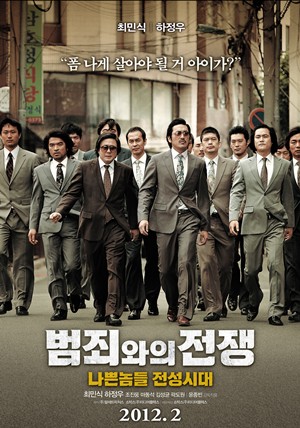
(Old boys - Korean, n.d.)
(Old boys - Korean, n.d.)
Yakuza in Japan were treated
with respect in many films relating to them. Unlike gangster in Singapore,
Yakuza adopts a well-established hierarchy system. Japanese do not see these
Yakuza the same way as how Singaporean sees the gangster. They operate openly
and they are also found to be more effective than the government in disasters
relief effort in Kobe (James, 1995). They deal with drug trafficking and other illegal
operations as a form of living while the gangster in Singapore holds another
job. Yakuza are seen to instill fear in the audience in many Japanese films
whereas Singapore gangster in 15 generates a sense of empathy.
Kkangpae in Korea holds
another identity that differs from the rest. They are seen in the movie Old
Boys (2012) as a professional organization. Unlike Singapore gangsters who
dress in school uniform and casual attire, they are dressed in suits. They
presented themselves well and the general public does not judge them as beyond
hopes. The movie poster of Old Boys also suggested that these Kkangpae are not
afraid to be seen in the public.
The Singapore Police Force
(SPF) views the film as a channel that might promote the secret societies in
Singapore as real gang name were mentioned. It was also criticized as a film
that lack moral message (John, 2004). The film showed the down side of the Singapore
society that was neglected. It was also criticized that Singaporean should not
be educated about secret societies through a film like this with no intention.
Months after the release of 15, the National Crime Prevention Council and the
SPF released a movie called “After School” (“After School,” 2003). The intention of the film is the same as 15 but it
aims to educate Singaporean about gang life through showing consequences and a
proper story plot.
Bibliography and References
After School. (2003).
Retrieved from http://www.ncpc.gov.sg/afterschool/index.html
James, S. (1995,
January 22). QUAKE IN JAPAN: GANGSTERS; Gang in Kobe Organizes Aid for People
In Quake. Retrieved from
http://www.nytimes.com/1995/01/22/world/quake-in-japan-gangsters-gang-in-kobe-organizes-aid-for-people-in-quake.html
John, A. (2004, January
5). Police censor fly-on-wall tale of gang life. Retrieved from
http://www.theguardian.com/world/2004/jan/05/film.filmcensorship
Old boys - Korean. (n.d.). Retrieved from
http://www.cityonfire.com/wp-content/uploads/2012/02/Nameless-Gangster.jpg
Royston Tan: Something
to remember. (2010, October 16). Retrieved from
http://news.asiaone.com/News/Latest+News/Showbiz/Story/A1Story20101016-242612.html
Yakuza Tattoo. (n.d.). Retrieved from
http://2.bp.blogspot.com/-PqBBvl5Z_P0/UVmYUIEEBWI/AAAAAAAAArs/_sHEg1Sbf4s/s1600/1.jpg
